
Introduction
Electronic circuits are the foundation of modern technology, enabling devices to process signals, control electrical power, store information, and communicate with other systems. From simple LED lighting circuits to sophisticated microprocessors, electronic circuit designs play a critical role in almost every electrical and electronic application.
Understanding the different types of electronic circuit designs is essential for the development of electronics product such as consumer electronics products as well as for optimizing their performance.
This article explores the major types of electronic circuit designs, their characteristics, working principles, and practical applications across various industries.
1. Analog Circuit Design
Analog circuit design involves developing electronic circuits that process continuous signals. Unlike digital circuits, which operate using discrete logic levels, analog circuits work with continuously varying voltage and current signals.
These circuits are essential for measuring, amplifying, filtering, and conditioning real-world signals such as sound, temperature, pressure, and light.
Common Components Used in Analog Circuits
- Resistors
- Capacitors
- Inductors
- Diodes
- Bipolar junction transistors (BJTs)
- Metal-oxide-semiconductor field-effect transistors (MOSFETs)
- Operational amplifiers (op-amps)
Types of Analog Circuits
Amplifier Circuits: Amplifiers increase the amplitude of electrical signals. They are widely used in audio equipment, sensor interfaces, and communication systems.
Filter Circuits: Filters allow specific frequency ranges to pass while attenuating unwanted frequencies. Common examples include low-pass, high-pass, band-pass, and band-stop filters.
Oscillator Circuits: Oscillators generate periodic electrical signals without requiring a periodic input signal. They are used in clock generation, signal generation, and communication systems.
Signal Conditioning Circuits: These circuits modify sensor outputs to make them suitable for processing by microcontrollers or other electronic systems.
Applications of Analog Circuit Design
- Audio amplifiers and sound systems
- Medical instrumentation
- Temperature and pressure measurement
- Radio receivers
- Industrial sensors
- Signal processing equipment
2. Digital Circuit Design
Digital circuit design involves electronic circuits that process information using discrete logic states, typically represented by binary values 0 and 1.
Digital circuits form the foundation of modern computing, automation, and embedded systems. They are designed using logic gates and semiconductor devices that perform Boolean operations.
Types of Digital Circuits
Combinational Circuits: The output depends entirely on the current input values. Examples include adders, subtractors, multiplexers, demultiplexers, and encoders.
Sequential Circuits: These circuits use memory elements to store previous states, making their outputs dependent on both current inputs and past conditions. Examples include counters, registers, and flip-flops.
Microprocessor and Microcontroller Circuits: These circuits integrate processing capabilities with other functional blocks to execute instructions, control peripherals, and perform computational tasks.
Applications of Digital Circuit Design
- Computers and laptops
- Digital clocks
- Industrial automation
- Embedded control systems
- Consumer electronics
- Automotive electronics
- Data processing equipment
Digital circuit design is particularly important in applications requiring accuracy, repeatability, programmability, and high-speed information processing.
3. Power Electronic Circuit Design
Power electronic circuit design focuses on controlling and converting electrical energy efficiently. These circuits use semiconductor switching devices to regulate voltage, current, frequency, and power flow.
Power electronics is a critical area of modern engineering, particularly in renewable energy systems, electric vehicles, industrial machinery, and power supplies.
Types of Power Electronic Circuits
| Circuit Type | Function |
|---|---|
| AC to DC Converter (Rectifier) | Converts alternating current into direct current |
| DC to DC Converter | Changes one DC voltage level to another |
| DC to AC Converter (Inverter) | Converts direct current into alternating current |
| AC to AC Converter | Changes AC voltage or frequency |
| Motor Drive Circuit | Controls motor speed, torque, and direction |
Common Components
- Power MOSFETs
- Insulated-gate bipolar transistors (IGBTs)
- Diodes
- Thyristors
- Inductors
- Transformers
- High-voltage capacitors
- Gate driver ICs
Applications of Power Electronic Circuit Design
- Electric vehicle charging systems
- Solar inverters
- Uninterruptible power supplies (UPS)
- Industrial motor drives
- Battery management systems
- Renewable energy conversion
- Switching power supplies
The primary objective of power electronic design is to achieve high conversion efficiency, thermal stability, reliability, and safe operation under varying loads.
4. Mixed-Signal Circuit Design
Mixed-signal circuit design combines analog and digital circuitry within a single electronic system or integrated circuit. These designs are particularly important because real-world signals are analog, while modern processors generally operate on digital data.
Mixed-signal circuits enable communication between physical sensors and digital processing systems.
Key Components
Analog-to-Digital Converter (ADC): Converts continuous analog signals into digital values that can be processed by microcontrollers and processors.
Digital-to-Analog Converter (DAC): Converts digital information into corresponding analog signals.
Phase-Locked Loop (PLL): Generates and synchronizes clock signals, making it essential in communication and timing applications.
Mixed-Signal Microcontrollers: Integrate processing cores with ADCs, DACs, timers, and other analog peripherals.
Applications of Mixed-Signal Circuit Design
- Sensor-based embedded systems
- Medical monitoring equipment
- Audio processing systems
- Industrial measurement instruments
- Automotive control systems
- Data acquisition systems
- Wireless communication devices
Mixed-signal design requires careful consideration of noise, grounding, signal integrity, and interference between analog and digital sections.
5. Radio Frequency (RF) Circuit Design
Radio frequency circuit design involves developing electronic circuits that operate at high frequencies to transmit, receive, and process electromagnetic signals.
RF circuits are fundamental to wireless communication technologies, enabling devices to exchange information without physical connections.
Unlike low-frequency circuits, RF designs require special attention to impedance matching, transmission lines, electromagnetic interference, and parasitic effects.
Types of RF Circuits
- RF amplifiers
- Low-noise amplifiers (LNAs)
- Power amplifiers (PAs)
- Mixers
- Oscillators
- RF filters
- Impedance matching networks
- Antenna feed circuits
Applications of RF Circuit Design
- Wi-Fi and Bluetooth devices
- Cellular communication systems
- Satellite communication
- Radar systems
- GPS receivers
- Internet of Things (IoT) devices
- Wireless sensor networks
RF circuit design is especially relevant to emerging technologies such as 5G, advanced wireless connectivity, and connected industrial systems.
6. Embedded System Circuit Design
Embedded system circuit design involves developing dedicated electronic hardware that performs specific functions within a larger device or product.
These circuits typically combine microcontrollers, sensors, communication interfaces, power management components, and supporting circuitry. They are designed to operate reliably with limited processing power, memory, and energy consumption.
Essential Components of Embedded Circuits
- Microcontrollers and microprocessors
- Sensors and actuators
- Memory devices
- Voltage regulators
- Clock circuits
- Reset circuits
- Communication interfaces
- Programming and debugging connectors
Applications of Embedded Circuit Design
- Smart home devices
- Industrial automation
- Medical devices
- Automotive control systems
- Wearable electronics
- Robotics
- Smart agriculture
- Consumer appliances
Embedded circuit design is closely connected to firmware development. Engineers must consider both hardware and software requirements to ensure that the complete system operates correctly.
7. Sensor and Instrumentation Circuit Design
Sensor and instrumentation circuit design focuses on detecting physical quantities and converting them into electrical signals that can be measured or processed.
These circuits are essential for applications where accurate monitoring and control of environmental or operational parameters are required.
Types of Sensor Circuits
Temperature Measurement Circuits: Use thermistors, thermocouples, or integrated temperature sensors to monitor thermal conditions.
Pressure Measurement Circuits: Interface with pressure transducers to measure gas or liquid pressure.
Light Detection Circuits: Use photodiodes, phototransistors, or light-dependent resistors to detect light intensity.
Current and Voltage Measurement Circuits: Monitor electrical parameters for energy management, protection, and control.
Signal Conditioning Circuits: Amplify, filter, and linearize sensor outputs to improve measurement accuracy.
Applications
- Industrial process monitoring
- Medical diagnostic equipment
- Environmental monitoring
- Smart agriculture
- Automotive sensing
- Energy management systems
- Scientific instrumentation
The accuracy of sensor circuit design depends on factors such as noise reduction, calibration, component tolerance, temperature stability, and signal resolution.
8. Power Supply Circuit Design
Power supply circuit design focuses on providing stable and regulated electrical power to electronic devices. Almost every electronic product requires a power supply circuit to convert input energy into appropriate voltage and current levels.
Power supply designs can be broadly classified into linear and switching power supplies.
Linear Power Supplies
Linear power supplies use regulating devices operating in their linear region to maintain a stable output voltage. They are relatively simple and can provide low-noise outputs, although they generally dissipate more power as heat.
Switching Power Supplies
Switching power supplies use high-frequency switching techniques to achieve efficient power conversion. They are widely used in compact electronic devices because of their high efficiency and smaller size.
Applications
- Mobile phone chargers
- Computers and laptops
- Industrial control systems
- LED lighting
- Medical electronics
- Communication equipment
- Battery charging systems
Power supply circuit design requires careful selection of components, thermal management, protection mechanisms, and electromagnetic compatibility considerations.
9. Motor Control Circuit Design
Motor control circuit design involves developing electronic systems that regulate the speed, torque, direction, and position of electric motors.
These circuits are widely used in automation, robotics, automotive systems, and industrial machinery.
Types of Motor Control Circuits
DC Motor Driver Circuits: Control the direction and speed of DC motors, often using H-bridge configurations.
Stepper Motor Driver Circuits: Control the angular position of stepper motors through precise electrical pulses.
Brushless DC (BLDC) Motor Controllers: Use electronic commutation to control brushless motors efficiently.
Servo Motor Control Circuits: Regulate angular position or speed using feedback mechanisms.
Applications
- Robotics
- CNC machines
- Industrial automation
- Electric vehicles
- Drones
- Smart appliances
- Conveyor systems
Motor control circuit design requires consideration of current ratings, switching losses, electromagnetic interference, feedback systems, and thermal performance.
10. High-Speed Digital Circuit Design
High-speed digital circuit design focuses on electronic systems that operate at high data rates or contain fast switching signals.
At high frequencies, circuit behavior is influenced by transmission line effects, parasitic capacitance, inductance, crosstalk, and electromagnetic interference.
Consequently, high-speed designs require more advanced PCB layout techniques than conventional low-speed digital circuits.
Key Design Considerations
- Signal integrity
- Impedance control
- Differential pair routing
- Crosstalk reduction
- Power integrity
- Ground plane design
- Electromagnetic compatibility (EMC)
Applications
- Computer motherboards
- High-speed communication equipment
- Data acquisition systems
- Networking hardware
- FPGA-based systems
- High-speed memory interfaces
- Advanced embedded computing
High-speed circuit design is particularly important in modern computing and communication systems, where reliable data transmission is essential.
Comparison of Different Types of Electronic Circuit Designs
The following table summarizes the major electronic circuit design categories and their applications.
| Circuit Design Type | Primary Function | Common Applications |
|---|---|---|
| Analog Circuit Design | Processes continuous signals | Audio systems, sensors, amplifiers |
| Digital Circuit Design | Processes binary information | Computers, microcontrollers, logic systems |
| Power Electronic Design | Converts and controls electrical power | EVs, inverters, motor drives |
| Mixed-Signal Design | Integrates analog and digital processing | Data acquisition, medical devices |
| RF Circuit Design | Transmits and receives high-frequency signals | Wi-Fi, radar, wireless communication |
| Embedded Circuit Design | Performs dedicated control functions | IoT, robotics, smart devices |
| Sensor Circuit Design | Detects and measures physical parameters | Industrial monitoring, instrumentation |
| Power Supply Design | Provides regulated electrical power | Chargers, computers, electronic products |
| Motor Control Design | Controls motor operation | Automation, robotics, electric vehicles |
| High-Speed Digital Design | Supports high-speed data transmission | Networking, computing, FPGA systems |
Key Considerations in Electronic Circuit Design
Designing a functional electronic circuit involves more than selecting components and connecting them according to a schematic. Engineers must consider several technical and practical factors to ensure that the circuit performs reliably under real-world conditions.
1. Component Selection
Selecting appropriate components is essential for achieving the desired electrical performance. Engineers must evaluate voltage ratings, current capacity, power dissipation, tolerance, operating temperature, availability, and cost.
2. Power Consumption and Efficiency
Power consumption is particularly important in battery-powered devices, wearable electronics, and portable products. Efficient circuit design helps extend battery life and minimize heat generation.
3. Thermal Management
Electronic components generate heat during operation. Excessive temperatures can reduce performance, shorten component lifespan, and cause system failure. Thermal design may involve heat sinks, copper planes, thermal vias, and appropriate component placement.
4. PCB Layout and Routing
Printed circuit board (PCB) layout directly influences circuit performance. Proper routing, grounding, component placement, and trace width are important for minimizing noise, reducing interference, and maintaining signal integrity.
5. Electromagnetic Compatibility (EMC)
Electronic circuits should operate without generating excessive electromagnetic interference or becoming vulnerable to interference from other devices. EMC considerations are especially important in automotive, medical, industrial, and communication systems.
6. Testing and Validation
Circuit testing verifies whether the design meets its functional and electrical requirements. Engineers commonly use oscilloscopes, multimeters, logic analyzers, signal generators, and electronic loads to evaluate circuit behavior.
Simulation tools such as LTspice, KiCad, and MATLAB can also help engineers analyze circuit performance before manufacturing.
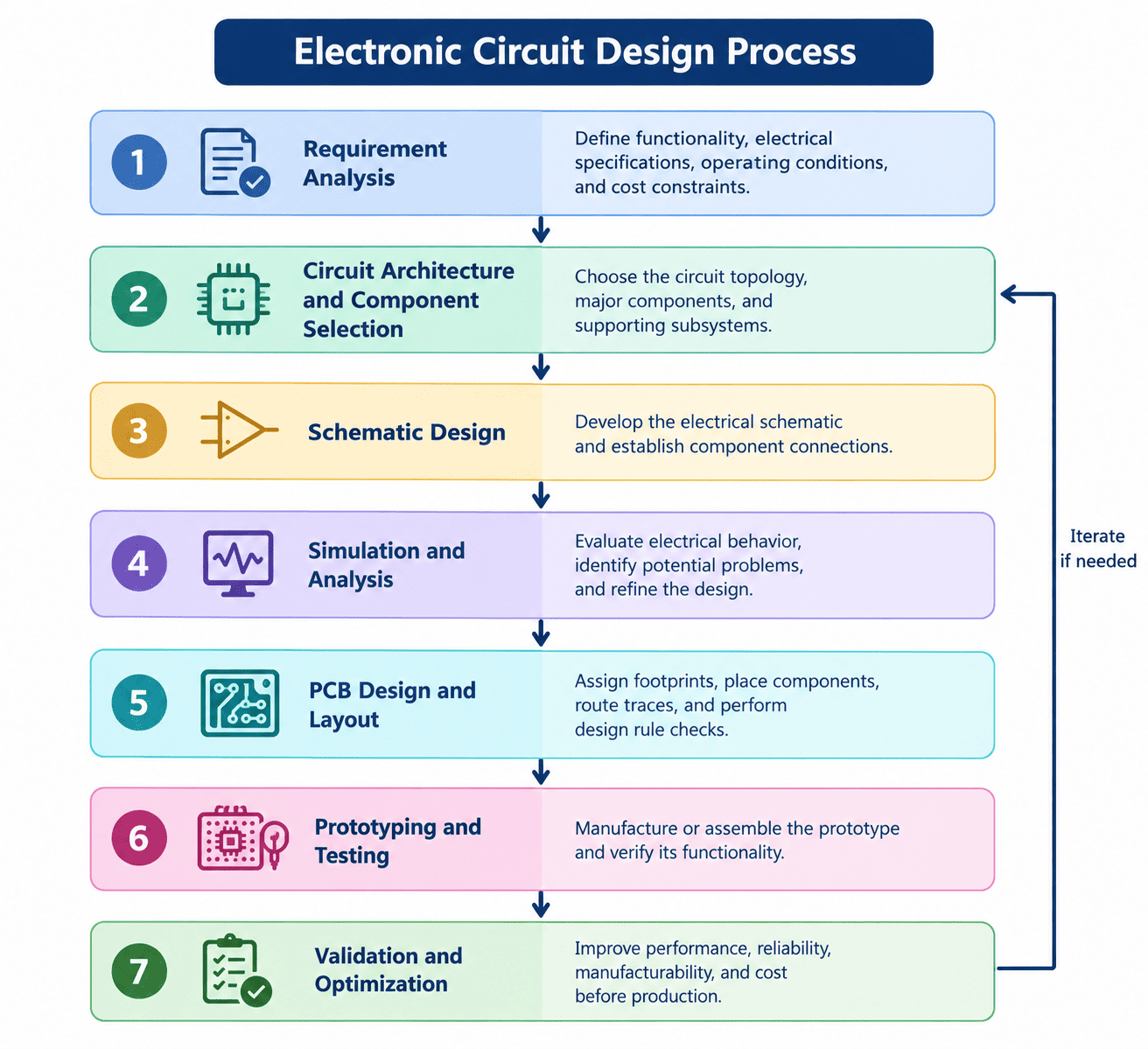
Electronic Circuit Design Process
The electronic circuit design process typically follows a structured engineering workflow.
Conclusion
Electronic circuit design encompasses a wide range of engineering disciplines, each serving a specific purpose in modern technology. Analog circuits process continuous signals, digital circuits handle binary information, power electronic circuits manage energy conversion, and mixed-signal circuits connect real-world signals with digital processing systems.
Specialized designs such as RF circuits, embedded systems, sensor interfaces, motor controllers, and high-speed digital circuits enable the development of increasingly sophisticated electronic products.
Understanding the different types of electronic circuit designs is essential for engineers involved in product development, PCB design, embedded systems, automation, and emerging technologies. By selecting the appropriate circuit architecture and following a systematic design process, engineers can create electronic systems that are efficient, reliable, cost-effective, and suitable for real-world applications.
Frequently Asked Questions (FAQs)
1. What are the main types of electronic circuit designs?
The main types include analog circuit design, digital circuit design, power electronic circuit design, mixed-signal circuit design, RF circuit design, embedded system circuit design, sensor circuit design, power supply design, motor control design, and high-speed digital circuit design.
2. What is the difference between analog and digital circuit design?
Analog circuit design deals with continuously varying electrical signals, whereas digital circuit design processes discrete logic states, typically represented by binary values 0 and 1. Analog circuits are commonly used for amplification and signal conditioning, while digital circuits are used in computing, control, and data processing.
3. Which software is used for electronic circuit design?
Popular electronic circuit design tools include KiCad, Altium Designer, OrCAD, Autodesk Eagle, LTspice, Proteus, and MATLAB. The choice depends on whether the task involves schematic design, PCB layout, circuit simulation, or system-level analysis.
4. What is the importance of PCB design in electronic circuits?
PCB design provides the physical platform for connecting electronic components. Proper PCB layout improves electrical performance, reduces electromagnetic interference, supports thermal management, and enhances the reliability and manufacturability of electronic products.
5. What is mixed-signal circuit design?
Mixed-signal circuit design combines analog and digital circuitry within a single system. It is commonly used in sensor interfaces, medical equipment, audio systems, and embedded devices that convert real-world signals into digital data for processing.
6. What are the applications of power electronic circuits?
Power electronic circuits are used in electric vehicles, solar inverters, battery chargers, industrial motor drives, UPS systems, renewable energy systems, and switching power supplies. Their primary function is to control and convert electrical energy efficiently.
7. How do engineers test electronic circuit designs before manufacturing?
Engineers use circuit simulation, schematic checks, PCB design rule checks (DRC), and electrical analysis before manufacturing. Physical prototypes are then tested using oscilloscopes, multimeters, logic analyzers, and other laboratory instruments to verify performance and reliability.
Ready to Turn Your Idea into a Market Ready Product??
We provide end to end research services.Get in touch to turn your idea into a market ready product.
Learn More