
Quantum Computers vs Classical Computers: 10 Differences
Computers have transformed almost every aspect of modern life, from communication and healthcare to finance, engineering, and scientific research. For decades, this transformation has been driven by classical computers, which process information using bits represented as 0s and 1s. However, a fundamentally different approach to computation is emerging through quantum computing.
Quantum computers use principles of quantum mechanics to process information in ways that are fundamentally different from conventional computers. This does not mean that quantum computers will simply replace today’s laptops, smartphones, or servers. Instead, quantum computing is being developed to solve certain classes of problems that are extremely difficult or impractical for classical computers.
Understanding the difference between quantum and classical computing requires looking at how information is represented, processed, and measured.
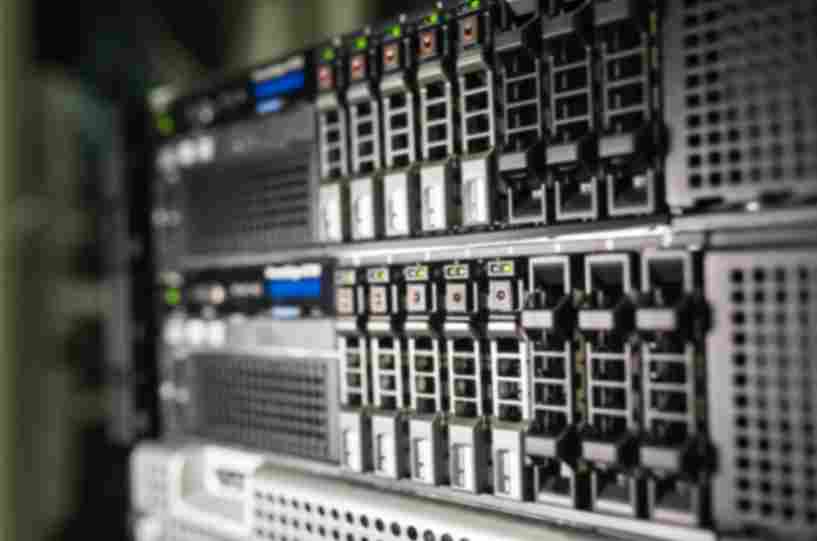
Difference in the Working of Classical Computers Vs Quantum Computers
1. Information Unit
A classical computer stores information in bits. A bit can have only one state at a time: 0 or 1
For example, 8 bits can represent one of: 00000000,00000001,00000010,…,11111111
So 8 classical bits have 256 possible combinations, but when you read the computer’s state, you get one particular 8-bit combination.
A quantum computer uses a qubit. A qubit can be in a quantum state described as: ∣ψ⟩=α∣0⟩+β∣1⟩
where α and β are probability amplitudes satisfying: ∣α∣^2+∣β∣^2=1
This is called superposition.
Importantly, this does not simply mean that a qubit is a classical bit containing both 0 and 1. When measured, the qubit gives either 0 or 1, with probabilities determined by its quantum state.
2. Information Behaviour
Classical computers generally produce the same output when the same operation is performed with the same input. Quantum computers, however, can produce different results each time an operation is measured because their outputs are probabilistic. A quantum computer assigns probabilities to different possible outcomes, and the final result depends on which outcome occurs during measurement. This is similar to real-world events where several outcomes are possible, each with its own probability.
3. Functional Units
A classical computer works on Von- Neumann architecture and has its functions divided into several units such as- Central Processing Unis consisting of control unit and an arithmetic logic unit,memory unit, input units like keyboard , mouse and output units such as monitor, display, speaker, printer etc.
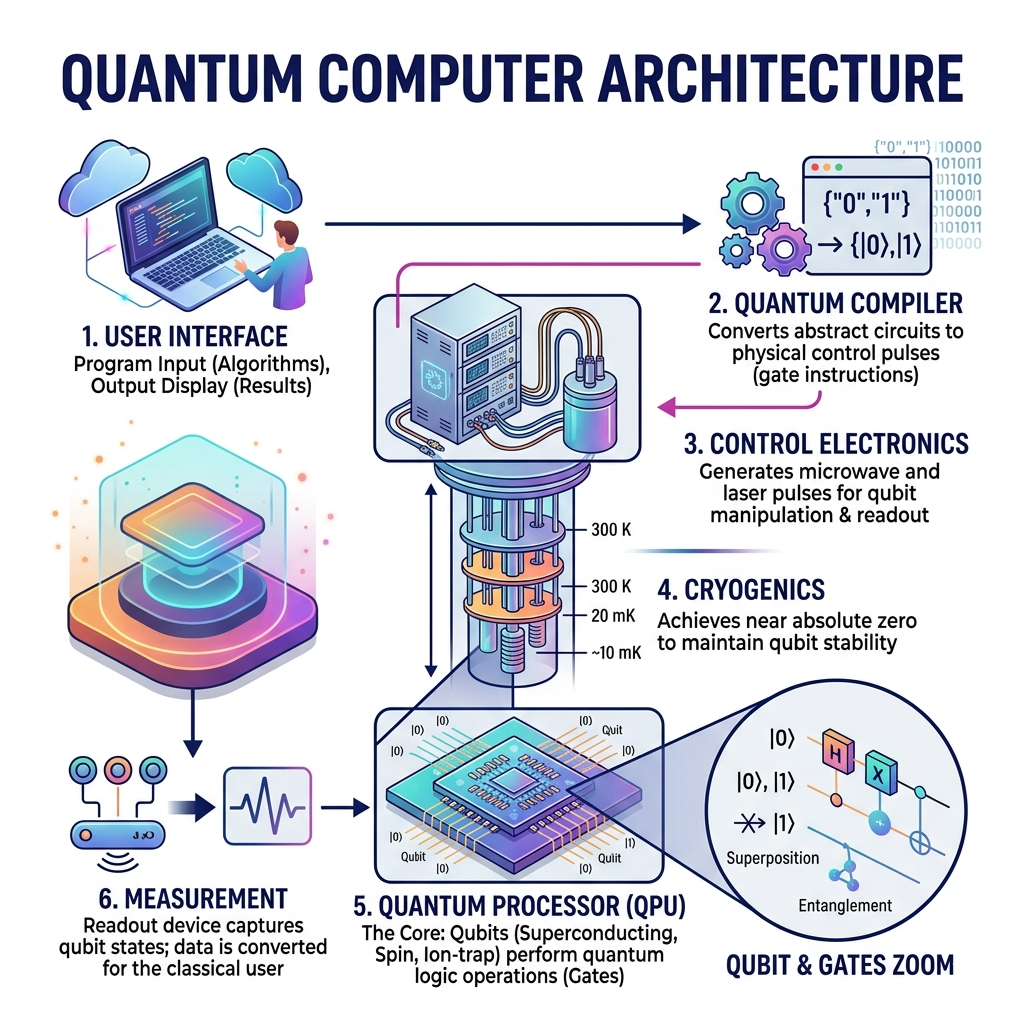
A quantum computer architecture includes several specialized functional units. A quantum computer has several specialized units. The state preparation unit initializes qubits, usually starting them in the ∣0⟩ state, and prepares them for computation. The Quantum Processing Unit (QPU) contains qubits and quantum gates that manipulate their states. These gates can create superposition, where a qubit can represent a combination of 0 and 1, and entanglement, where qubits become strongly connected.
Quantum computers also need systems to store and protect quantum information, as qubits are easily disturbed by their surroundings. This disturbance is called decoherence. The measurement unit finally measures the qubits and converts the quantum results into classical 0s and 1s. Classical control electronics operate the quantum hardware and process the measurement results.
Thus, a practical quantum computer is actually a combination of quantum hardware and classical computing hardware.
4. Operating Conditions
Classical and quantum computers differ significantly in their operating conditions. Classical computers are designed to function under relatively normal environmental conditions, whereas quantum computers require highly controlled environments to preserve fragile quantum states.
Classical Computers
Classical computers generally operate at or near room temperature. They use cooling systems such as fans, heat sinks, or liquid cooling to prevent overheating. Controlled humidity is preferred to avoid corrosion, electrical leakage, and electrostatic discharge. A stable power supply is also important for reliable operation. Although electromagnetic interference can affect sensitive electronics, classical computers generally have reasonable tolerance to environmental disturbances.
Quantum Computers
Quantum computers require much stricter operating conditions. Superconducting quantum computers typically operate at extremely low temperatures, around 10–20 millikelvin, using dilution refrigerators. Some other quantum technologies, such as trapped-ion systems, require ultra-high vacuum instead.
Quantum computers are highly sensitive to environmental disturbances such as electromagnetic radiation, magnetic fields, mechanical vibrations, temperature fluctuations, and unwanted particle interactions. These disturbances can cause decoherence, resulting in the loss of quantum information.
Therefore, quantum computers require specialized cooling, shielding, isolation, and precise control systems. Their operating conditions depend on the particular quantum technology being used.
5. Error Sensitivity
Classical and quantum computers differ significantly in their sensitivity to errors.
Classical computers are relatively resistant to small physical disturbances. Their information is stored as bits, represented by distinct states of 0 or 1. Digital circuits use voltage ranges to distinguish these states, so small fluctuations in voltage or noise usually do not change the stored information. Classical computers also use techniques such as error detection and correction to improve reliability.
Quantum computers are much more sensitive to errors because qubits exist in delicate quantum states. Environmental disturbances such as temperature fluctuations, electromagnetic interference, vibrations, and interactions with surrounding particles can alter the quantum state. This can cause decoherence and errors in quantum computations.
Quantum systems therefore require sophisticated error-control techniques. Quantum error correction uses multiple physical qubits to protect quantum information.
6. Structure and Hardware
Classical computers are built using electronic components such as transistors, processors, memory, storage devices, and input/output units. The CPU contains the ALU, control unit, and registers, and processes information using binary bits (0 and 1).
Quantum computers are built around qubits, implemented using technologies such as superconducting circuits, trapped ions, neutral atoms, or photons. Their hardware includes a Quantum Processing Unit (QPU), control and measurement systems, and classical computing components. Depending on the technology, they may require cryogenic refrigerators, vacuum chambers, lasers, or electromagnetic shielding to maintain stable quantum states. Thus, quantum computers require specialized hardware and controlled environments.
7. Computation Speed
Classical computers perform computations using bits and electronic logic gates. Modern CPUs can execute billions of operations per second, making them extremely fast for general-purpose tasks. Their performance depends on factors such as processor frequency, number of cores, memory speed, and architecture.
Quantum computers work differently. They are not necessarily faster than classical computers for every task. Their advantage comes from quantum effects such as superposition, entanglement, and interference, which can provide significant speedups for certain problems.
For example, quantum algorithms can offer major advantages in areas such as cryptography, quantum simulation, and some optimization and search problems.
8. Mathematical Modeling
Classical computers use mathematical models based on conventional mathematics, numerical methods, and Boolean algebra. They represent information using binary values (0 and 1), with Boolean algebra providing the mathematical foundation for logical operations such as AND, OR, and NOT. These operations are implemented using logic gates to perform calculations and make decisions. Classical computers use algorithms to solve equations and model physical systems, financial markets, weather, engineering systems, and other real-world processes.
Quantum computers use mathematical models based on quantum mechanics and linear algebra. Information is represented using vectors in a complex vector space, while quantum operations are represented by matrices called unitary operators. Probabilities are obtained by measuring the resulting quantum state.
Thus, classical computing mainly models systems using classical equations and numerical algorithms, while quantum computing can model certain quantum-mechanical systems more naturally and may provide computational advantages for specific complex problems.
9. Purpose
Classical computers are designed for general-purpose computing. They are used for everyday tasks such as data processing, internet applications, document creation, programming, scientific calculations, business operations, and multimedia processing. They are reliable and efficient for a wide range of conventional computational tasks.
Quantum computers are designed primarily to solve specific computational problems that are difficult for classical computers. Their potential applications include quantum-system simulation, cryptography, optimization, drug and material discovery, and certain complex mathematical problems.
Thus, classical computers are general-purpose machines suitable for most everyday and computational tasks, while quantum computers are specialized systems intended to provide advantages for particular complex problems.
10. Physics
Classical computers are based primarily on classical physics, particularly principles of electromagnetism and semiconductor physics. Transistors control electrical signals to represent and process binary information. Their operation can generally be described using conventional electrical and electronic laws.
Quantum computers, on the other hand, are based on the principles of quantum mechanics. Their operation depends on phenomena such as superposition, entanglement, quantum interference, and measurement. Qubits are physical quantum systems whose behavior follows quantum-mechanical laws.
Thus, the fundamental physical basis is different:
Classical computers → Classical physics + semiconductor electronics
Quantum computers → Quantum mechanics + specialized physical systems
This difference in physical principles is the foundation for the different ways classical and quantum computers process information.
Conclusion
The difference between classical and quantum computing lies fundamentally in how information is represented and processed.
Classical computers use bits and electronic logic circuits, while quantum computers use qubits and exploit quantum phenomena such as superposition, entanglement, and interference.
Classical computing remains the dominant technology and is likely to remain essential for everyday computing. Quantum computing, meanwhile, is being developed for specialized problems involving areas such as cryptography, chemistry, materials science, and optimization.
The most important point is that quantum computers are not universally faster computers. Their potential comes from using fundamentally different computational principles to tackle particular problems.
As quantum hardware, algorithms, and error-correction techniques continue to improve, the relationship between classical and quantum computing is likely to become increasingly important. The future of computing may therefore not be a choice between classical and quantum machines, but a combination of both technologies working together.
Ready to Turn Your Idea into a Market Ready Product??
We provide end to end research services.Get in touch to turn your idea into a market ready product.
Learn More